Tuesday, October 15, 2013

Rock and Roll Ain't Noise Pollution

     Have you ever thought about all the things that you use in a 24 hour period? From the moment we wake up to the time we go to sleep, and even in between, we continually use things that one way or another came from resources our Earth has provided. My assignment is to evaluate and assemble a list of all the different types of things I used in just one day of my life which was 10/14/13.

Food and Drink                                                    Housing
  • Cereal                                                           -My house
  • Turkey sandwich                                          -Arby's restaurant
  • Fries
  • Soda
  • Water
  • Hot pocket
Transportation and Roads                                   Clothing                                     
  •  My 2006 Nissan Sentra                               -Shirt   -Belt   -Hat
  • Used numerous roads and freeways             -Pants  -Socks
  • Traveled about 220 miles                             -Boxers  -Shoes

Personal Care Products                                        Leisure Items
  • Toothbrush                                                    -Smart phone
  • Toothpaste                                                     -Laptop computer
  • Mouthwash                                                    -LED Television
  • Shampoo                                                        -Jackson Dinky Guitar
  • Body wash                                                     -Xbox game console
  • Facial cleanser
  • Deodorant
  • Q-tips
Miscellaneous Items
  • Mattress
  • Pillows
  • Blanket
  • Chairs
  • Tables
  • Cups
  • Refrigerator
  • Oven
  • Silverware
  • Glass bowl
     I would have to say my favorite and most prized item on this list is my guitar, a Jackson DKXT Dinky model. I did some research to find out just what it's made out of.

What it's made of
Basswood, maple, and rosewood make up the body, neck, and fingerboard. Body finish (paint) includes polyester and polyurethane. Pickups are quite interesting, they are responsible for making sound by picking up wave lengths from the vibrations of the strings. Pickups are made of ferromagnetic material, therefore strings are made of nickel, a magnetic metal.

How it's used
It is used to make notes that if placed in a sequence can produce music.

How, where, and by whom was it acquired?
Since the primary ingredient in my guitar is wood, trees had to be cut down to make it. The metals had to be excavated from mines and treated, they most likely have a deal with a big metal company. On the back of my guitar it says it was made in India, so Indian laborers gathered the materials and assembled it.

How did it get to me?
Well after it was assembled in India, it was most likely transported to the nearest port, then placed on a ship to the US. I got it over ebay, its original location was Brooklyn, NY. So it then traveled on a truck across the country to the deep south of Houston, TX, where it made its way to me.

Where will it go when it is no longer useful to me?
Assuming something did happen to my baby which would ultimately crush me, it would end up in a landfill and remain buried there for a very long time.

Effect on environment
Other than noise pollution, I don't think my guitar does much harm. Even if it breaks in half, most parts are small and can be removed and used on another guitar or somewhere else. Until it ends up in a landfill, will any harm be done because none of its parts are biodegradable.

Was it available 100 years ago?
The first electric guitars where introduced in the 1930's so no, but earlier forms such as sitars can be traced to ancient civilizations as far back as 3,000 years.

                                                                    And here she is..

Tuesday, October 8, 2013

Many factors can determine how sustainable RCC is and/or could be. Energy consumption, waste production and removal, transportation, and water usage are among the top subjects; which break off into subcategories like paper usage, emissions into the atmosphere, food products and recycling.

-Electric and utility bills can assess energy and resource consumption
-Disposal of solid and septic waste could be determined by contacting the waste management company to evaluate how much paper, plastic, biodegradable trash we produced and WHERE
it goes.
-Methods of transportation can be assessed by surveying students, asking what types of vehicles they drive and how many times are they at campus a week. Also by counting the number parking permits sold in a semester.

San Francisco Sustainability

The University of San Francisco is among one of the top sustainable campuses in the country.
Since 2008, the university has achieved an 8% reduction in greenhouse gas emissions. To reduce energy use, USF operates a cogeneration facility, has implemented temperature setbacks, and has installed energy management systems in nearly half of campus buildings. The university also uses LED lighting, lighting sensors, and energy efficient lighting. Solar panels generate renewable energy on campus as well.
Campus report cards can be seen here,
LINK >>http://www.greenreportcard.org/
 
What's in RCC's trash?
 
An observational study can be conducted in which we analyze and measure all the types of trash produced by RCC in one month. The trash produced in that month would be taken to a single location, and then categorized accordingly (paper, plastic, metals). Measure all the categories within themselves then sum up the total. We could get students in science classes to do the labor for credit.


Monday, September 30, 2013

Capturing the Western Frontier


     My profession as a property manager requires me to travel throughout southern California; scouting foreclosed properties with the intent to aquire them at auction. In the course of a week, I have observed and explored several different types of ecosystems, analyzing the biotic and abiotic factors of each one. These are MY OWN photosa small glimpse of capturing the western frontier.  

Aguanga, CA
Biotic factors include the shrubs displaying a uniform distribution pattern. It was very quiet the only sound was the wind whispering, and there wasn't even one bird in the sky. Abiotic factors include the rocks, dead tree(bottom right corner), and dirt/sand. Interactions may include competition between plants for resources(water) and space.

                                                                     
                                                              NEXT STOP...
                                                                                                         
                                                                                                                            Big Bear Lake, CA
Biotic factors include all the organisms living in the water including: fish, bacteria, and plants. From my observations, the San Bernardino forest is looking quite healthy, with thousands of alive and dead pine trees providing a habitat for many species of birds as seen in the background. The birds and trees display a commensalism relationship, the birds live in the trees and the trees are unaffected.
When I was there I also noticed a slimy green substance lining the banks of the lake, which might include some algae or decaying plant matter(abiotic) as seen in the bottom left corner. The lake itself is also an abiotic factor.


I took this photo on Highway 18 near Crestline, biotic factors include all the green vegetation and birds in the sky. Abiotic factors include rocks, dirt and ice (snow) in the winter, and the smog generated by San Bernardino in the distance.
 QUEST THROUGH THE DESERT
 
The Mojave Desert covers a significant portion of southeastern California, it is home to the San Jacinto Mountains and cities like Barstow, Palm Springs, CA and Las Vegas, NV. In this picture I took off Highway 62 going towards Yucca Valley, you can see a perfect example of uniform distribution displayed by the shrubs. As I kneeled quietly, I noticed several lizards and other reptilians, sunbathing. All of which are biotic  factors. Some abiotic factors are the many small rocks and sand covering the landscape, also the hills in the background which affect climate.
 

HAVE YOU REACHED YOUR DESTINATION? 

Monday, September 16, 2013

Chindi Shush - "Ghost Bear"

     In the Navajo language, Chindi Shush means "the bear who has turned ghost."
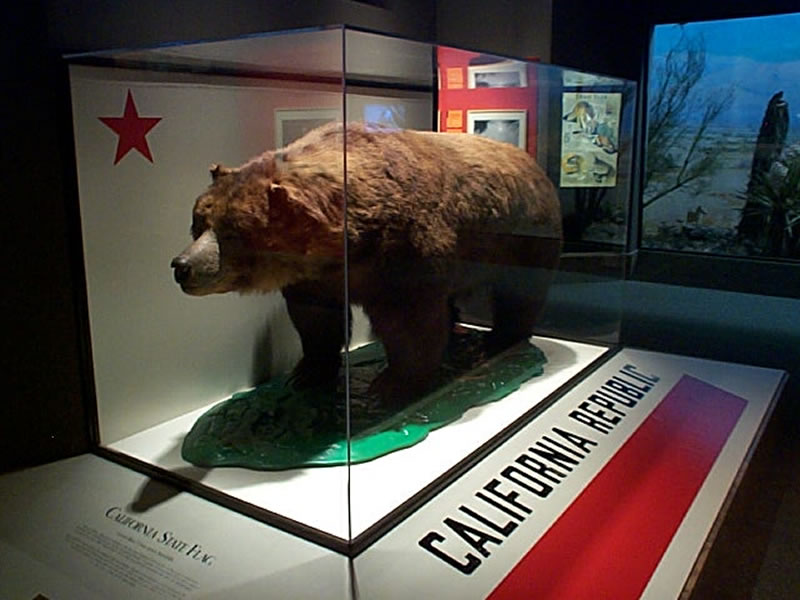
This statement is the epitome of how to describe what happened to our state animal, the California Grizzly (Ursus arctos californicus).

     Before California was nicknamed the "Golden State" it was actually the "Bear State", infamous for the thousands of monstrous grizzlies that once inhabited the region. As pioneers started migrating west during the 1840's due to the gold rush, these animals were being exterminated by hunters for their pelts and other valuable organs. This went on until in 1922, the last California grizzly was shot and taken in Tulare County. Although being endangered some 40,000 grizzlies still reside in Canada and Alaska. This article gives some information about the history and laws in place to protect these majestic animals. http://www.netstate.com/states/symb/animals/ca_grizzly_bear.htm
File:Monarch the bear.jpg

Khutzeymateen Grizzly Bear Sanctuary
Stock Photo #1990-18753, A male Grizzly Bear Ursus arctos horribilis stands on his hind legs to check for other bears in the area, at Khutzeymateen Grizzly Bear Sanctuary, North of Prince Rupert, British Columbia, Canada
     On the pacific coast of British Columbia, Canada there is a 110,000 acre sanctuary for these creatures where hunting them is strictly prohibited. The Khutzeymateen Valley is Canada's only grizzly bear sanctuary and home to one of BC's most important coastal populations of grizzly bears in the world. An estimated 50 grizzlies live in the park along with a vast majority of other critters that include wolves, beavers, otters, porcupine and other black bears.
http://www.spacesfornature.org/greatspaces/khutzey.html

Wednesday, September 11, 2013

Dude, I think your hair is on fire .. Yeah it is HAHA!

     If you've ever had long hair you know the hassle that comes with this carefree style. When I did have long hair I preferred the "rolled out of bed" look, but most prefer the moussed up, hairspray or overly gelled look. My friend Daniel was one of those people. One day when we were hanging out, he decided to smoke a cigarette. Upon lighting it in his mouth, a small piece of his hair combusted, producing a small glow that I noticed. I then chuckled the words, "Dude, I think your hair is on fire .. Yeah it is HAHA!" He quickly muttered an obscenity and put it out, we got quite the laugh.

     So what is it that makes these commonly used products flammable and how can you trust putting them in your hair? Not just styling products, but also shampoos and conditioners, contain solvents such as alcohol and hydrocarbons which are flammable. Another ingredient in styling products is polyvinylpyrrolidine, which is also used to glue the layers of wood in plywood together. Some hairsprays use natural polymers and solvents like vegetable gums dissolved in alcohol(still flammable). One popular ingredient in these "natural" sprays is gum arabic, it's made from the sap of certain trees that grow in the Sudan. So the answer is: You can't really trust any hair product and have to measure the benefits from the risks for the sake of your hair.
http://antoine.frostburg.edu/chem/senese/101/consumer/faq/hairspray-ingredients.shtml

Thursday, August 29, 2013

Jammil Montoya Bio & Ecological Footprint

Hello,
   
    Allow me to introduce myself, my name is Jammil Montoya and I live in Riverside, CA.
I moved here about a year ago from where I am from, Houston, TX to pursue a career in real estate; which is going quite well. I plan to major in Business Administration to comply to the worlds ever changing markets and needs. I dream to one day become a real estate broker that not only buys and sells property, but also improves properties to raise living standards and profit. I chose environmental science as my first college level course because I am very interested in the habitats and creatures this world yields, and I find it easy to grasp.
     I have a lot of hobbies that I love to do on my spare time which include: playing guitar, skateboarding, snowboarding, working out, hanging with the homies, and taking the occasional trip back to Houston to visit family and friends. One question that I would like to be answered this semester is: What is Earths status on global warming today and what are we doing to slow this inevitable process down? In conclusion, I am excited and motivated to succeed in this class and begin to continue my education.


Ecological Footprint

     An ecological footprint is the measure of demand humans have on nature. If everyone on Earth lived as I do, it would take 6.2 Earths to maintain sustainability. The three top contributing factors to my footprint are mobility (38%), services (32%) and food (12%). A couple of ways I can reduce my impact are carpooling, recycling, reduce consumption of animal products, and using energy efficient appliances and/or solar paneling my house.